How to Build a Mobile Workbench Cart
Mobile workbench cart plans help create a stable work surface that can move when floor space is limited. This guide covers the base, storage, top and locking casters.
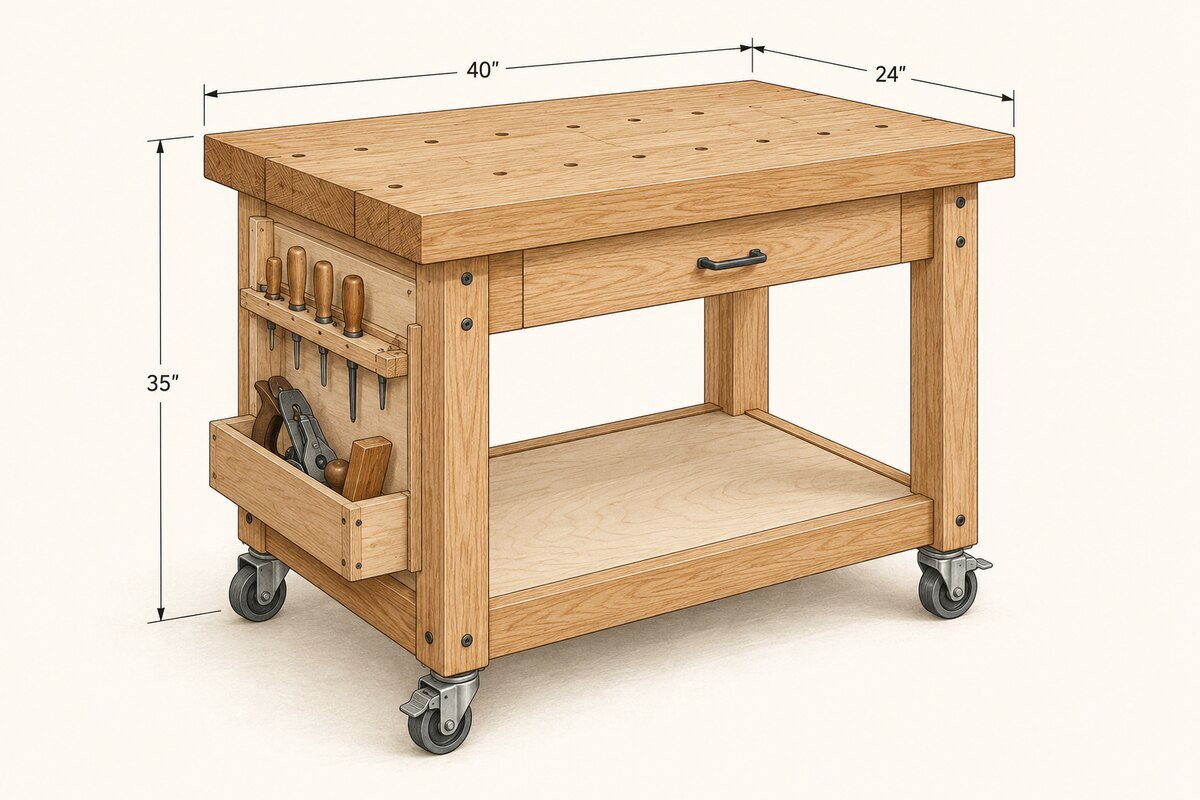
Materials and tools
- Flat cabinet-grade plywood or straight, dry lumber
- Project-appropriate screws, wood glue and hardware
- Circular saw or table saw, drill/driver and square
- Clamps, measuring tools and random-orbit sander
- Eye and hearing protection
Materials for mobile workbench cart plans
Choose straight framing and flat sheet material because mobile workbench cart plans rely on a square base to keep all four casters touching the floor.
Mobile workbench cart plans: before you cut
Good mobile workbench cart plans begin with the available floor space, doorway width, comfortable bench height and the heaviest tool the top must support.
Measure the available space and mark the finished footprint with masking tape. Confirm access, movement and hardware clearances before buying material. Read the complete plan once, label every part and choose one reference face for all measurements.
Three checks that prevent rework
- Confirm actual material thickness and the finished outside dimensions.
- Mark related parts from the same reference face and edge.
- Test moving hardware and critical joints on scrap before final assembly.
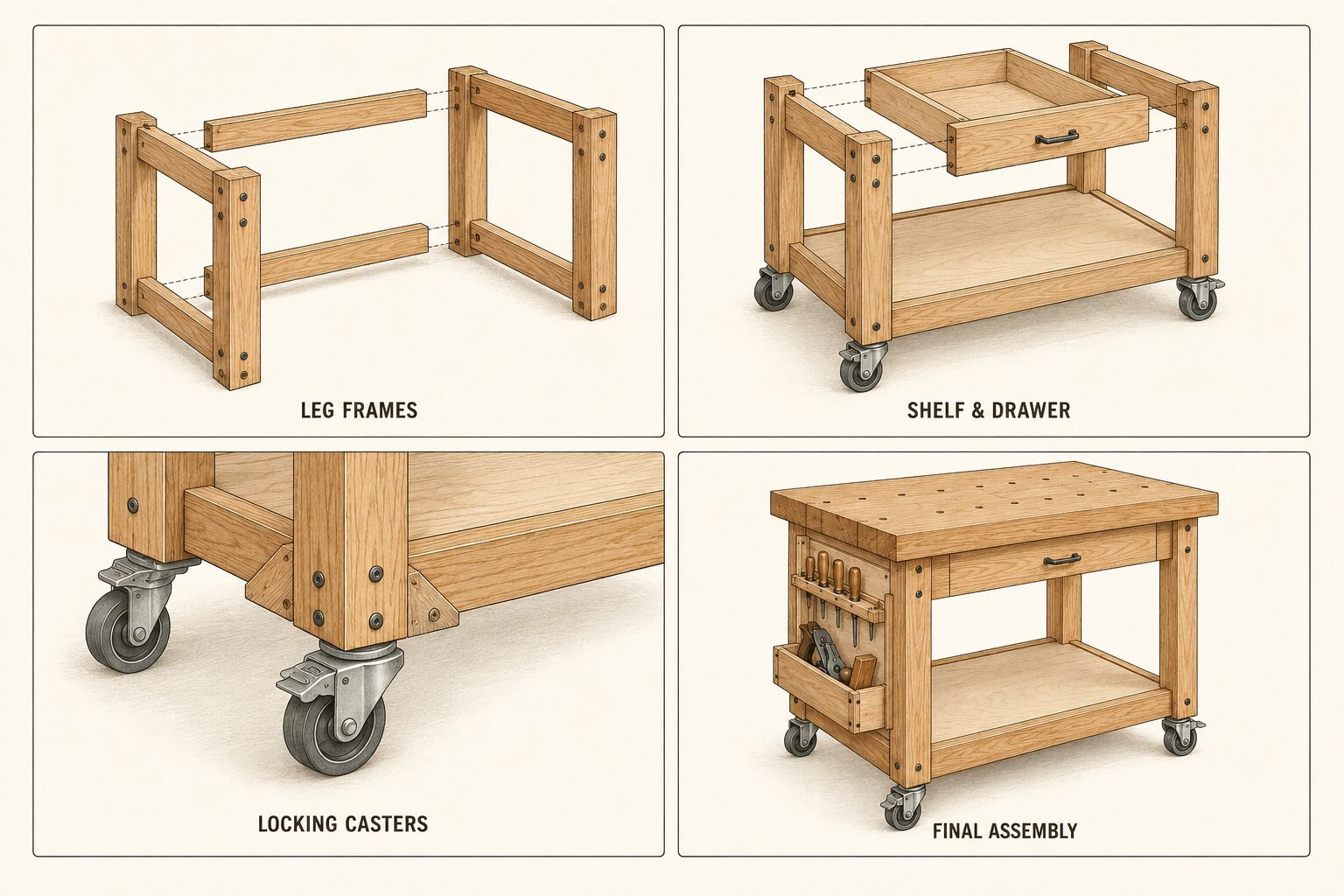
Selecting casters and planning the frame
Select four load-rated casters, including at least two locking swivel casters. Add the estimated bench weight, tools and project load, then choose a generous safety margin.
Work from one reliable reference face and compare the part with the drawing before moving on. Check mating pieces together rather than trusting repeated measurements. A short dry fit here is faster than correcting accumulated errors after assembly.
Assembling the leg frames
Build the end frames with identical legs and rails. Clamp them together while marking so every rail lands at the same height.
Work from one reliable reference face and compare the part with the drawing before moving on. Check mating pieces together rather than trusting repeated measurements. A short dry fit here is faster than correcting accumulated errors after assembly.
Adding the lower shelf and storage
Install the lower shelf inside a rigid perimeter frame. Leave enough clearance above the casters for the brake levers and add a lip if stored tools may slide.
Work from one reliable reference face and compare the part with the drawing before moving on. Check mating pieces together rather than trusting repeated measurements. A short dry fit here is faster than correcting accumulated errors after assembly.
Building and attaching the worktop
Laminate or edge-band the worktop and keep it flat during glue-up. Overhangs should be large enough for clamps but not so large that the cart becomes unstable.
Work from one reliable reference face and compare the part with the drawing before moving on. Check mating pieces together rather than trusting repeated measurements. A short dry fit here is faster than correcting accumulated errors after assembly.
Squaring, locking and load testing
Check the frame for rack, tighten all bolts and test every caster lock. Load the bench gradually and push from several directions before normal workshop use.
Work from one reliable reference face and compare the part with the drawing before moving on. Check mating pieces together rather than trusting repeated measurements. A short dry fit here is faster than correcting accumulated errors after assembly.
Mobile workbench cart plans fail when the caster rating ignores the bench and tool weight, or when the base racks because it lacks a rigid back or bracing.
Common mistakes to avoid
- Starting before checking the available space, finished dimensions and material thickness.
- Measuring connected parts from different reference edges.
- Skipping a complete dry fit before glue or final hardware installation.
- Forcing an assembly into square instead of finding the inaccurate part.
- Ignoring the instructions supplied with tools and hardware.
Final quality check
Inspect the work from every side on a flat surface. Confirm that moving parts travel freely, fasteners are secure, exposed edges feel smooth and the finish is fully cured. Recheck critical fixings after the first period of normal use.
Safety
Wear suitable eye and hearing protection, support every workpiece securely and disconnect power before changing blades or bits. Use dust collection or a suitable respirator where required. Ask a qualified person to check wall-mounted or load-bearing work whenever the substrate, fixing method or expected load is uncertain.
These mobile workbench cart plans can be resized, but caster capacity, center of gravity, shelf span and doorway clearance must be recalculated together.
For general machine and workshop hazards, consult the OSHA woodworking safety guide.
Frequently asked questions
Can the dimensions be changed?
Yes, but update every connected part together. Recheck hardware clearances, symmetry, material spans and the order of assembly before cutting.
Is this suitable for a beginner?
A careful beginner can use this guide by practicing critical cuts on scrap and dry-fitting each stage. Ask an experienced woodworker to review structural, moving or wall-mounted connections.