Best Wood for Indoor Furniture
The best wood for indoor furniture balances strength, movement, appearance, availability and the tools you can use accurately. This guide compares practical choices for real home projects.
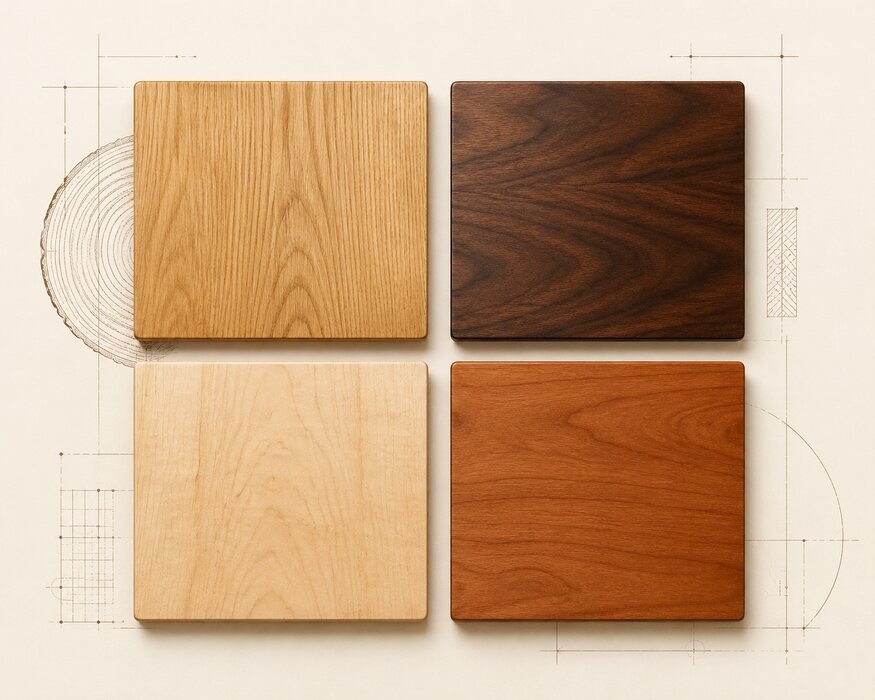
Best wood for indoor furniture: what to check first
Choosing the best wood for indoor furniture starts with the project load, expected humidity changes, finish and whether visible edges need attractive grain.
Start with the real project in front of you. Record its dimensions, material thickness and intended use. Read the complete guide before making a decision, then test the most important operation on an offcut.
Three checks that prevent rework
- Confirm actual material thickness and the finished outside dimensions.
- Mark related parts from the same reference face and edge.
- Test moving hardware and critical joints on scrap before final assembly.
How the best wood for indoor furniture is evaluated
We compare the best wood for indoor furniture by stiffness, dimensional movement, machining behavior, price and suitability for frames, tops, drawers or painted parts.
What makes wood suitable for furniture
Furniture wood should be dry, reasonably stable and appropriate for the expected wear. Appearance matters, but movement, hardness and availability determine long-term success.
Work from one reliable reference face and compare the part with the drawing before moving on. Check mating pieces together rather than trusting repeated measurements. A short dry fit here is faster than correcting accumulated errors after assembly.
Affordable woods for beginner projects
Pine and poplar machine easily and are economical for painted or beginner projects. Select straight boards and avoid loose knots in structural areas.
Work from one reliable reference face and compare the part with the drawing before moving on. Check mating pieces together rather than trusting repeated measurements. A short dry fit here is faster than correcting accumulated errors after assembly.
Durable hardwoods for long-term use
Oak, maple, cherry and walnut offer greater wear resistance and distinctive grain. Match the species to the tool set and the desired finish.
Work from one reliable reference face and compare the part with the drawing before moving on. Check mating pieces together rather than trusting repeated measurements. A short dry fit here is faster than correcting accumulated errors after assembly.
Wood movement and moisture
Solid wood expands across its grain as humidity changes. Allow tabletops and wide panels to move instead of fastening them rigidly across the grain.
Work from one reliable reference face and compare the part with the drawing before moving on. Check mating pieces together rather than trusting repeated measurements. A short dry fit here is faster than correcting accumulated errors after assembly.
Matching finish to the chosen species
Test stain, oil or clear coat on offcuts from the same boards. A simple clear finish often gives more consistent results than trying to force one species to imitate another.
Work from one reliable reference face and compare the part with the drawing before moving on. Check mating pieces together rather than trusting repeated measurements. A short dry fit here is faster than correcting accumulated errors after assembly.
The best wood for indoor furniture can still fail when boards are wet, grain direction is ignored or wide solid panels are fixed without allowing seasonal movement.
Common mistakes to avoid
- Starting before checking the available space, finished dimensions and material thickness.
- Measuring connected parts from different reference edges.
- Skipping a complete dry fit before glue or final hardware installation.
- Forcing an assembly into square instead of finding the inaccurate part.
- Ignoring the instructions supplied with tools and hardware.
Final quality check
Inspect the work from every side on a flat surface. Confirm that moving parts travel freely, fasteners are secure, exposed edges feel smooth and the finish is fully cured. Recheck critical fixings after the first period of normal use.
Safety
Wear suitable eye and hearing protection, support every workpiece securely and disconnect power before changing blades or bits. Use dust collection or a suitable respirator where required. Ask a qualified person to check wall-mounted or load-bearing work whenever the substrate, fixing method or expected load is uncertain.
There is no single best wood for indoor furniture; the right choice depends on structure, appearance, budget and how the finished piece will be used.
For general machine and workshop hazards, consult the OSHA woodworking safety guide.
Frequently asked questions
Can the dimensions be changed?
Yes, but update every connected part together. Recheck hardware clearances, symmetry, material spans and the order of assembly before cutting.
Is this suitable for a beginner?
A careful beginner can use this guide by practicing critical cuts on scrap and dry-fitting each stage. Ask an experienced woodworker to review structural, moving or wall-mounted connections.